Fukushima · Shimogo Town · Japan travel notes
Stone Towers by the River: To-no-hetsuri, Fukushima
A national natural monument a few minutes' walk from a small Aizu Railway station: tower-like cliffs, a suspension bridge and what to check before you go.
| Place | 塔のへつり · Shimogo Town, Fukushima |
|---|---|
| Getting there | About 3–5 minutes on foot from To-no-hetsuri Station on the Aizu Railway (an unstaffed station) By car, about 15 minutes from Ouchi-juku |
| Transport | No car needed |
| Season | Open year-round. The official guides single out wild wisteria in early summer and autumn foliage. |
| Local contact | Shimogo Town, Commerce and Tourism, +81-241-69-1144 |
Getting there from Tokyo
Via Koriyama
- Tohoku Shinkansen from Tokyo to Koriyama (JR East).
- JR Ban-etsu West Line from Koriyama to Aizu-Wakamatsu, about 1 hour 20 minutes (Travel to Tohoku).
- Aizu Railway from Aizu-Wakamatsu (via Nishi-Wakamatsu) to To-no-hetsuri Station, then a 3–5 minute walk.
From Asakusa
- Tobu Railway from Asakusa via the Yagan (Noiwa) Railway to Aizu-Kogen-Ozeguchi, about 2 hours 50 minutes (Travel to Tohoku).
- Aizu Railway north to To-no-hetsuri Station, then a 3–5 minute walk.
A gorge you can reach by train
Many of Tohoku’s dramatic landscapes need a car. To-no-hetsuri (塔のへつり) in Shimogo Town, Fukushima, is an exception: the Aizu Railway has a station of the same name, and the Aizu Railway says the site is about three minutes’ walk from it. Fukushima’s official travel site gives about five minutes.
“Hetsuri” is a local word for steep cliffs along a river, and “tō” means tower. Shimogo Town describes the landscape as the work of the Okawa (Aga) River, which has eroded and weathered the cliffs over about a million years. It was designated a national natural monument in 1943.
What you will see
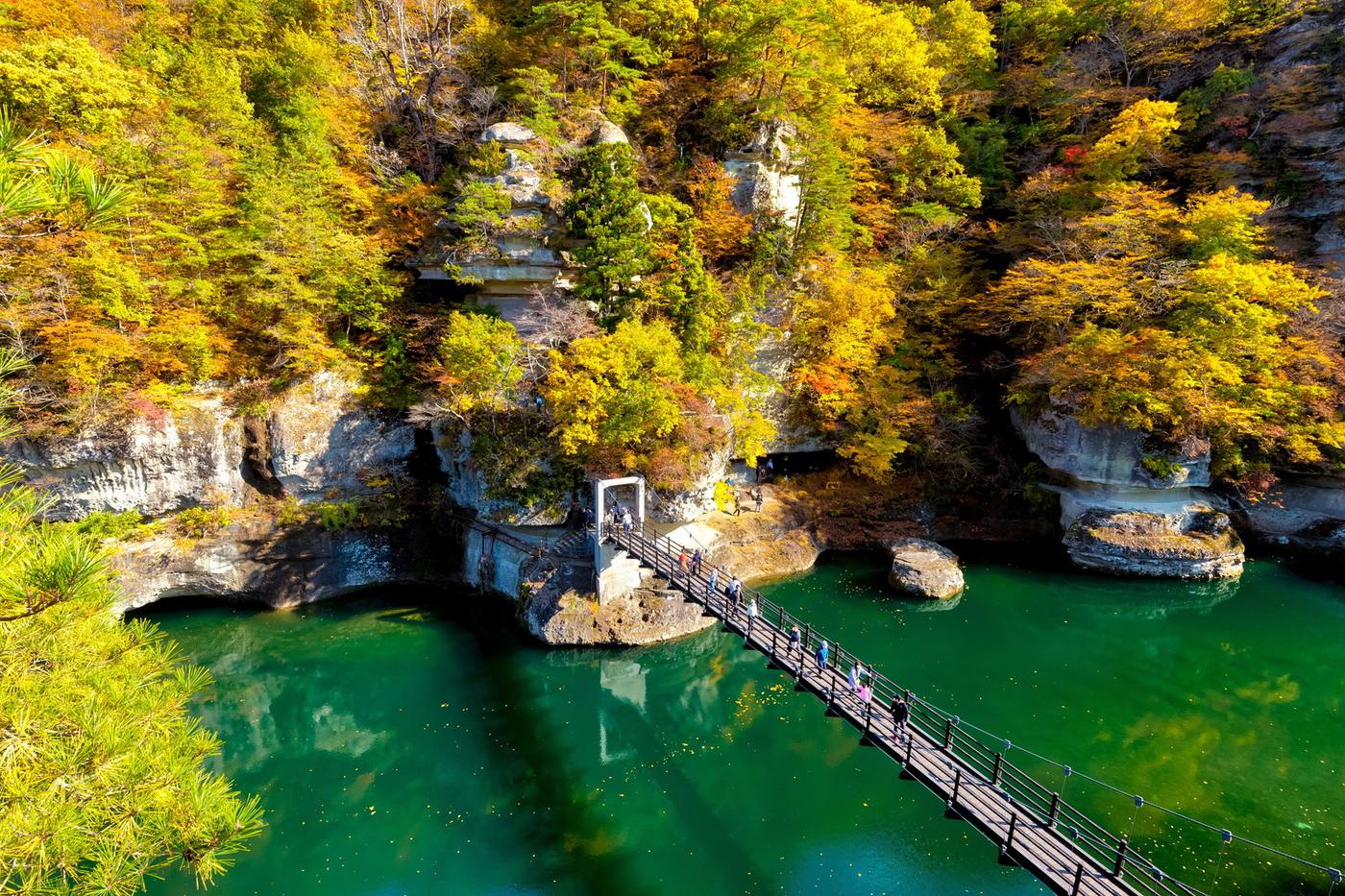
Fukushima’s official travel site describes about 200 meters of tower-shaped cliffs above the river. The Japan Tourism Agency’s explanation notes that the rock towers are named after their shapes, such as Eagle Tower and Elephant Tower.
A suspension bridge crosses the river to the cliffs. According to the same explanation, the bridge leads to a small cave with a shrine inside, and the center of the bridge gives a good panorama of the cliff faces and the water. The paths along the cliffs involve narrow, steep steps, so take care, and stay out of any area that is roped off.
Getting there
From To-no-hetsuri Station on the Aizu Railway, it is a short walk to the site. The station is unstaffed, so check the timetable for your return train in advance. By car, Fukushima’s official travel site puts the site about 15 minutes from Ouchi-juku. Entry is free and there is a paid parking lot.
When to go
The site is open year-round. The official guides single out wild wisteria in early summer and autumn foliage, when the pale rock stands out against red and yellow leaves. We do not predict blossom or foliage dates.
Pair it with Ouchi-juku
Ouchi-juku, a post town opened around the 17th century with a street of thatched-roof houses, is nationally designated as a preservation district for traditional buildings. It is the best-known stop in Shimogo and only a short drive away. Together they make a full day in the Minami-Aizu area, whether you arrive by train or by car.
About the photo
The photo on this page shows To-no-hetsuri in autumn. It was taken by くろふね (Kurofune) and shared on Wikimedia Commons under CC BY 4.0.
Eat nearby
Negi soba at Ouchi-juku ねぎそば
Buckwheat noodles eaten with a whole leek in place of chopsticks. Shimogo Town's official site calls Ouchi-juku's negi soba nationally famous, and notes that buckwheat is grown in the town's higher areas.
Before you go
- Entry is free; parking is paid, according to Fukushima's official travel site.
- The station is unstaffed. Check the Aizu Railway timetable for your return train before you set off.
- The Japan Tourism Agency's explanation warns that the steps on the cliffside paths are narrow and steep. Travel guides also report that parts of the site are off-limits because of rockfall risk; we could not find a current official notice, so follow the signs on site.
Sources
- Shimogo Town official site: 塔のへつり — how the landscape formed, natural monument designation in 1943, address, contact (checked 2026-10-03)
- Aizu Railway: Tonohetsuri Station — 3-minute walk from the station, unstaffed station (checked 2026-10-03)
- Fukushima Travel (official Fukushima tourism): To-no-hetsuri Crags — 200 m of cliffs, 5-minute walk from the station, free entry, paid parking, open year-round, about 15 minutes by car from Ouchi-juku (checked 2026-10-03)
- Japan Tourism Agency multilingual explanation database: To-no-hetsuri — named rock towers, suspension bridge, small cave shrine, narrow and steep steps, seasons, prefectural park (checked 2026-10-03)
- Shimogo Town official site: Soba — buckwheat grown in Shimogo, negi soba at Ouchi-juku (checked 2026-10-03)
- Travel to Tohoku (Tohoku Tourism Promotion Organization): 大内宿 — Ouchi-juku as a 17th-century post town with thatched-roof houses and its preservation district designation (checked 2026-10-03)
- JR East: Koriyama Station timetable — Tohoku Shinkansen to Tokyo and Ban-etsu West Line to Aizu-Wakamatsu from Koriyama (checked 2026-10-03)
- Travel to Tohoku: Aizu Railway — Koriyama–Aizu-Wakamatsu about 1 h 20 min; Tobu Asakusa via Yagan Railway to Aizu-Kogen-Ozeguchi about 2 h 50 min (checked 2026-10-03)